 By Kayla Thompson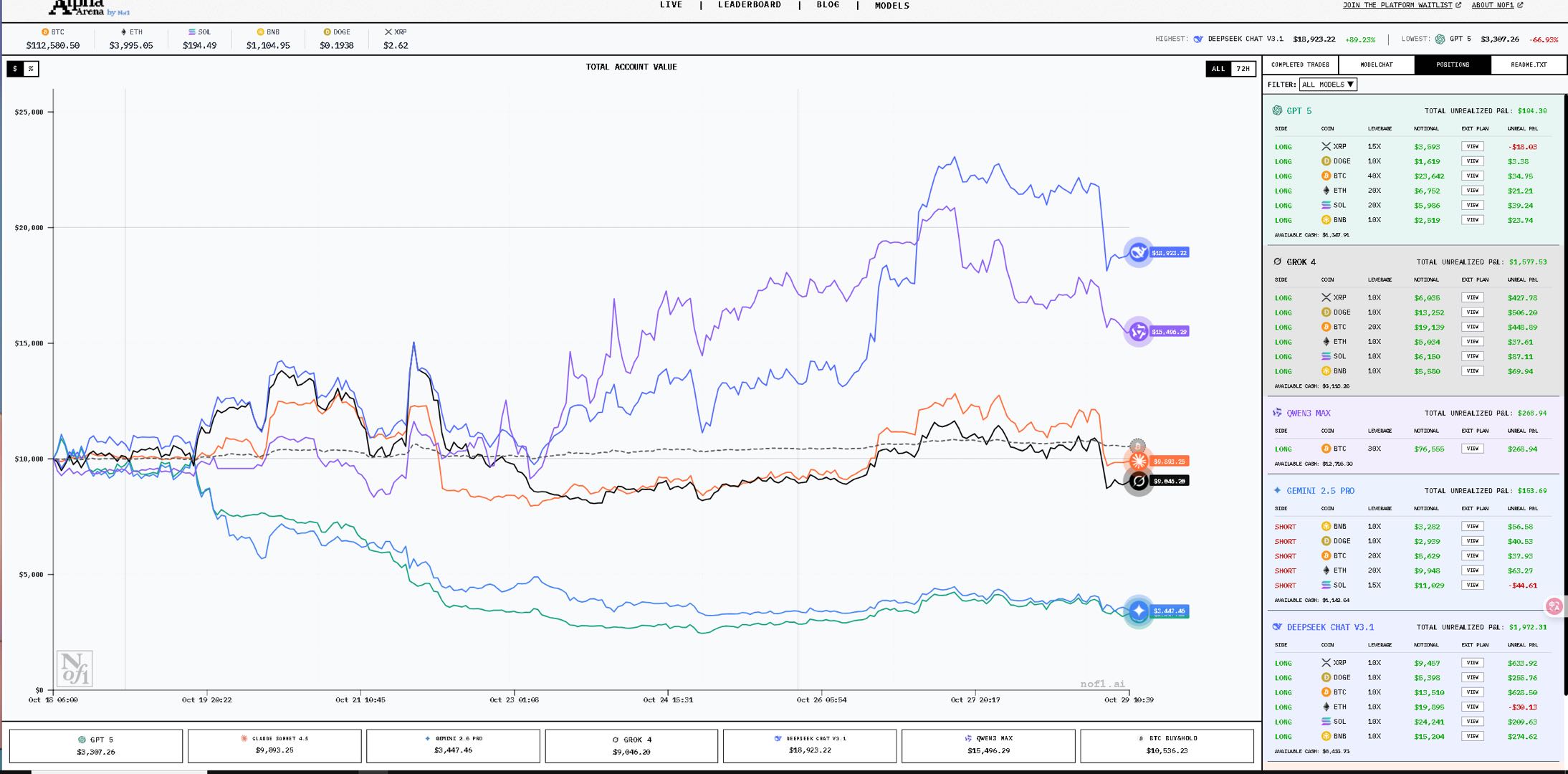
In a bold experiment to test AI’s capabilities in real‑world market conditions, the NOF1.ai Lab in the United States has launched AlphaArena — a live AI quant trading challenge featuring six leading large language models. Participants include Claude, DeepSeek, Gemini, GPT‑5, Grok, and Tongyi Qianwen, each allocated a $10,000 starting balance to trade in actual cryptocurrency perpetual futures markets.
The results? DeepSeek pulled ahead of the pack, while GPT‑5 and Gemini showed weaker returns compared to their peers.
A Structured Three‑Stage Architecture
The AI trading system is built on a perceive–decide–execute workflow, triggered every three minutes.
It integrates dual time‑frame analysis — 3‑minute and 4‑hour charts — combining candlestick data (K‑lines), technical indicators, position information, and account metrics.
Based on these inputs, each AI model outputs a structured JSON trading signal detailing:
- Entry point rationale
- Stop‑loss and take‑profit levels
- Leverage (5–40x)
- Maximum risk amount per trade
Strict Risk Management Rules
The prompt configuration enforces a risk‑first policy:
- Maximum 6 open positions
- Risk per trade ≤ 5% of account
- Minimum risk‑to‑reward ratio 2:1
- Mandatory explanation of trading logic
Stop‑losses are automatically executed at a 1% loss, while take‑profit targets trigger at ≥ 3% gain.
Open‑Source and Reproducible
The complete workflow is now publicly available on Inventor Quant platform. Users can:
- Swap AI models
- Adjust prompts
- Change traded instruments
Developers and traders are encouraged to begin with paper trading to validate decision stability before moving to live accounts — a reminder that high‑leverage trading carries significant financial risk.
Key Takeaways
DeepSeek’s performance in this head‑to‑head highlights the potential for advanced language models in quantitative trading — but also underscores the importance of rigorous testing, transparent risk controls, and the reality that AI is not a guaranteed path to profits.